EN
EN


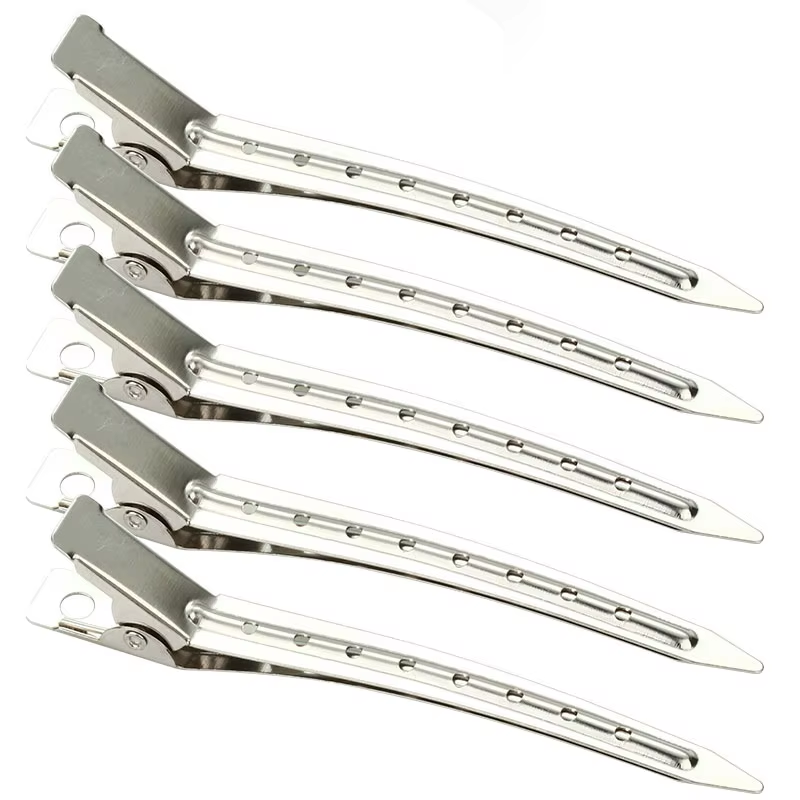
Hair clips are among the smallest tools in a stylist's kit, yet they have an outsized effect on the speed and quality of a service. Professional stylists use clips to section hair, control bangs, secure rollers, and separate color placements, and the right clip can turn a stressful appointment into a smooth one. A clip that slips, snaps, or snags on the hair slows down every step and damages the client's impression of the salon. This guide covers the must-have hair clips for professional stylists, explains what separates durable clips from disposable ones, and offers practical advice for buying hair clips wholesale for a salon or retail range.
Why Hair Clips Are Essential for Professional Stylists
Sectioning is the foundation of almost every haircut and color service. Without firm, slip-resistant clips, sections come loose mid-service, forcing the stylist to restart and producing uneven results. Bang clips hold the front hair out of the way while a fringe is cut or styled. During heatless or roller-set services, clips secure the ends of rollers. In color work, clips keep processed sections separated from untreated hair. In short, clips are not an accessory; they are part of the professional toolkit. Their unit price is low, but their impact on service consistency is high. For this reason, established salons treat clips as a consumable they standardize, choosing trusted models rather than the cheapest option.
Types of Hair Clips Every Stylist Should Have
The main categories are duckbill sectioning clips, nylon styling clips, bang styling clips, butterfly clips, and snap clips. Duckbill sectioning clips have a wide, flat jaw and a firm spring, making them ideal for holding large sections during cuts and colors. Nylon clips are lightweight, gentle on the hair, and available in multiple sizes and colors; the nylon material reduces pulling and suits fine hair well. Bang styling clips are curved to hold fringe away from the face during drying or styling, which helps build volume at the roots. Butterfly clips provide strong hold for thick sections and are common in perms and long-hair work. Snap clips are small press-on clips useful for pinning thin sections at the temples and the nape. A professional kit usually mixes sizes because one clip cannot fit every section thickness.
What Makes a Hair Clip High Quality
Quality in clips shows in the material, the spring, and the finish. Clips injection-molded from quality nylon have smooth edges that do not scratch the scalp or snag the hair. Spring strength matters: a spring that is too weak lets the clip slip, while one that is too strong leaves dents and tires the hand over a long day. A good clip holds firmly on the first placement and releases smoothly. The hinge should survive thousands of open-and-close cycles without loosening. Surface finish and colorfastness matter to wholesale buyers offering multiple colors. Because clips are molded in large volumes, the manufacturer's mold development capability is a direct quality factor: precise molds produce consistent, burr-free clips, while worn or sloppy molds produce rough edges that damage hair.
Choosing Hair Clips for Different Hair Types and Services
Fine, thin hair calls for lightweight nylon clips that grip gently. Thick, curly hair needs stronger springs and wider jaws. During color services, plastic or nylon clips are preferable to metal ones because they do not react with chemicals. For barbering, small snap clips hold precise sections for fading and clipper work. For long-hair styling and updos, butterfly clips and long duckbill clips keep large sections controlled. For children and clients with sensitive scalps, smooth-edged nylon clips with softer springs are the safer choice. Understanding these matches helps stylists build a kit that performs across every chair type. It also helps buyers ordering hair clip wholesale choose the right size mix instead of a single generic model.
Sourcing Hair Clips Wholesale: Quality Checks and Customization
Buyers stocking clips for resale or for a chain of salons should evaluate suppliers on a few points. First, confirm the material: clips should be molded from durable nylon or plastic that resists cracking under repeated use. Second, ask about mold condition and whether the factory develops its own molds, because this determines consistency from piece to piece. Third, verify quality management through certifications such as ISO9001, BSCI, and WCA. Fourth, check customization options: clip colors, logo printing, and packaging can all be customized, and OEM/ODM programs let a brand differentiate. Yiwu Zhichao Cosmetics Co., Ltd., which operates its own injection molding workshop in Yiwu and previously produced for MINISO, offers custom clip production with a starting MOQ of 100 pieces and a production start roughly 25 hours after order confirmation.
Case Study: A Salon Chain Standardizing Its Clip Inventory
A growing salon chain with twelve locations found that clip breakage and mismatched inventory were costing it time. Each location ordered clips independently, ending up with different sizes, colors, and quality levels. The chain worked with a single supplier in Yiwu to standardize on two nylon clip models and one bang styling clip in set colors. Because the supplier's MOQ was low and samples were provided before mass production, the chain tested the clips in two locations first. After three months, the chain reported fewer mid-service clip failures and simpler reordering. The supplier's 99% on-time fulfillment rate meant each location could restock on schedule without over-ordering. The case shows how standardizing a small consumable produces measurable operational benefits.
How to Build a Practical Clip Kit for Your Salon
A practical clip kit balances coverage and simplicity. Start with two dozen duckbill sectioning clips in two sizes. Add one to two dozen nylon clips in three colors so sections can be color-coded during color services. Put a set of bang styling clips at every station for fringe control. Keep a small tray of snap clips for barbering and fine detail work. Replace clips in batches rather than one by one, and discard any clip with cracks, burrs, or a weak spring immediately, because damaged clips snag hair. When ordering hair clip wholesale, buy spares in the same color codes so replacement stock does not create mismatched trays.
Frequently Asked Questions About Hair Clips
Q1: What is the difference between sectioning clips and styling clips?
A: Sectioning clips, such as duckbill clips, have wide jaws and firm springs designed to hold large sections during cutting and coloring. Styling clips, such as bang clips, are shaped to control specific areas like fringe and to support heatless styling.
Q2: Are nylon hair clips better than metal clips?
A: For most salon services, yes. Nylon clips are lightweight, do not react with color chemicals, and have smooth edges that are gentler on the scalp. Metal clips can hold very thick hair more strongly but may tarnish or react with chemicals.
Q3: What should buyers check before ordering hair clips wholesale?
A: Check the material and mold quality, request a pre-production sample, confirm the MOQ and customization options, and verify supplier certifications such as ISO9001, BSCI, and WCA.
Table of Contents
- Why Hair Clips Are Essential for Professional Stylists
- Types of Hair Clips Every Stylist Should Have
- What Makes a Hair Clip High Quality
- Choosing Hair Clips for Different Hair Types and Services
- Sourcing Hair Clips Wholesale: Quality Checks and Customization
- Case Study: A Salon Chain Standardizing Its Clip Inventory
- How to Build a Practical Clip Kit for Your Salon
- Frequently Asked Questions About Hair Clips